
Learn to Decode
The future of employment?

For years, the modern mantra was:
“Learn to code.”
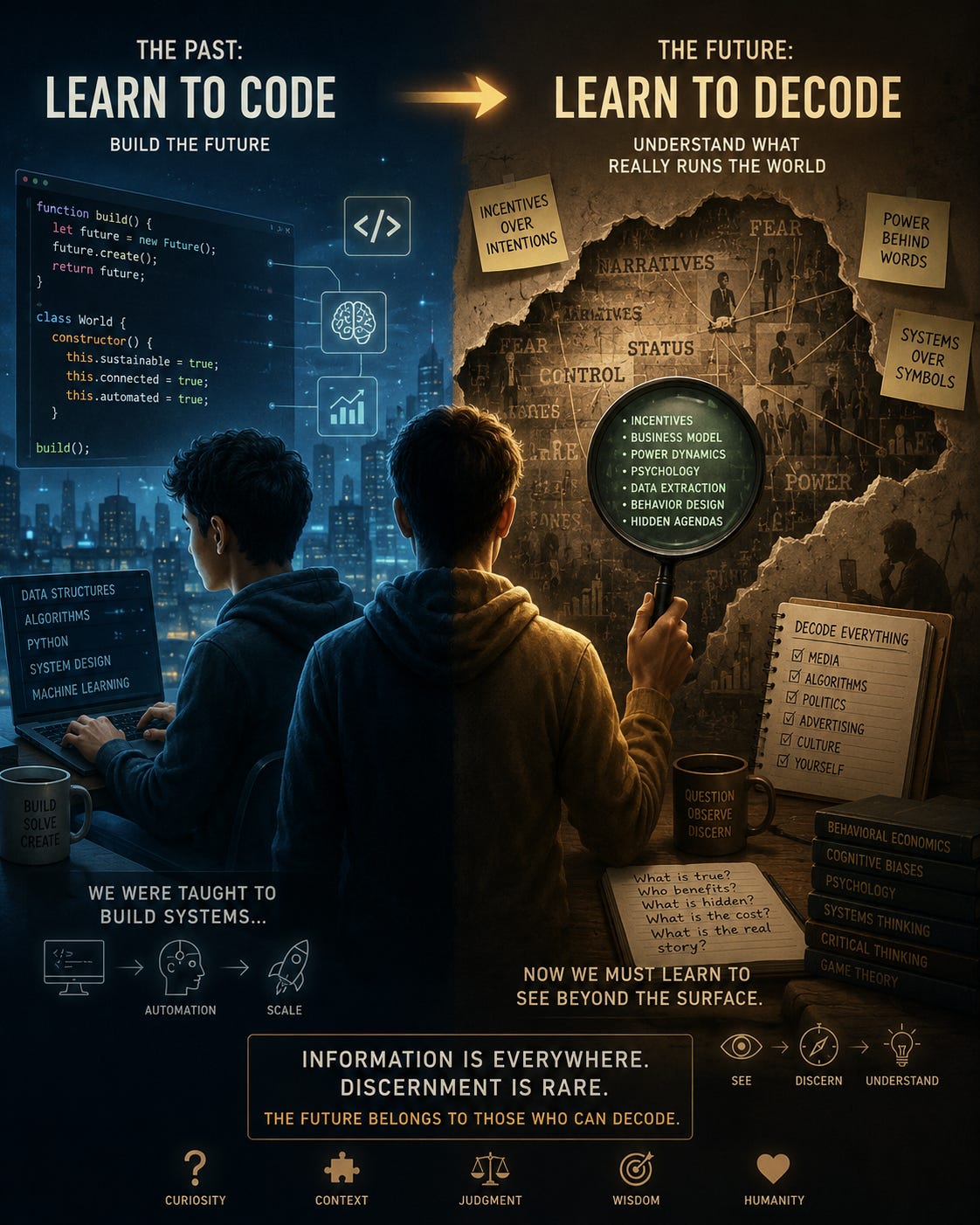
The assumption was that the future belonged to the people who could build systems, automate work, and instruct machines.
And for a while, that was true.
Coding became a form of power because the world itself was becoming software.
But now something deeper is happening.
AI can increasingly generate code.
Automation can increasingly build automation.
Machines can now imitate many forms of structured intelligence.
So the scarce skill is shifting.
The advantage no longer comes only from writing code.
It comes from understanding the hidden code already running the world.
Which means the new literacy is:
“Learn to decode.”
Decode incentives.
Decode systems.
Decode narratives.
Decode status games.
Decode business models.
Decode body language.
Decode politics.
Decode algorithms.
Decode media.
Decode your nervous system.
Decode your own reactions, fears and compulsions.
Because most of life is not explicit.
The real operating system is hidden beneath the interface.
A company says:
“We care about people.”
Decode:
What are the incentives?
What gets rewarded?
What gets punished?
What behaviour actually gets promoted?
A politician says:
“This is about safety.”
Decode:
Safety for whom?
At what cost?
What power is being gained?
What fear is being activated?
A social media platform says:
“We connect the world.”
Decode:
Attention extraction.
Advertising economics.
Behaviour shaping.
Engagement loops.
Even internally we must decode ourselves.
Why do we procrastinate?
Why do we freeze?
Why do we seek approval?
Why do we overwork?
Why do we sabotage good things?
Often the conscious story is not the real story.
The nervous system may be running old survival code installed decades ago.
So the future belongs not merely to coders, but to interpreters.
People who can see:
the hidden layer,
the incentive structure,
the emotional architecture,
the power dynamics,
the psychological frame,
the second-order effects.
In many ways, this is the shift from:
information → interpretation.
We already have overwhelming amounts of information.
What we lack is signal clarity.
And that is why discernment is becoming a superpower.
Not cynicism.
Not paranoia.
But the ability to ask:
“What is really happening here?”
The irony is that as AI becomes better at generating answers, humans may need to become far better at generating questions.
Because decoding begins with curiosity.
And perhaps that is the real evolution:
The industrial age rewarded obedience.
The information age rewarded knowledge.
The AI age may reward discernment.